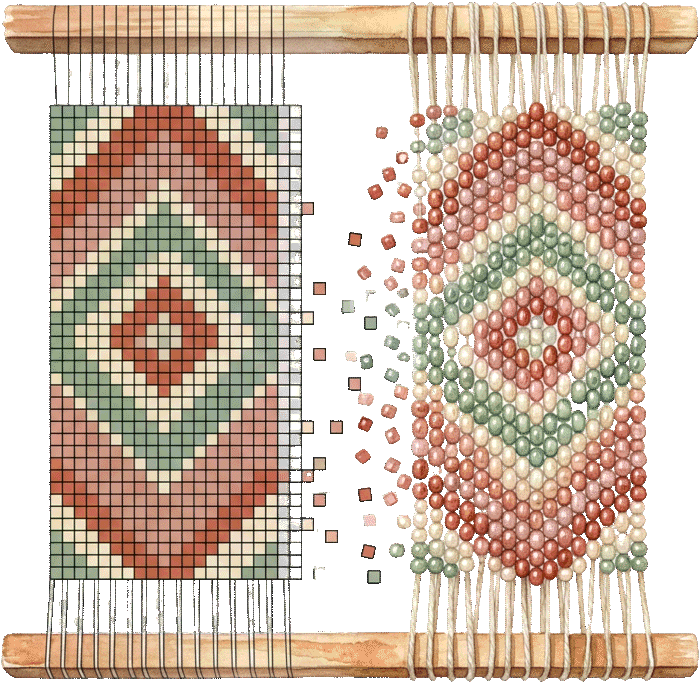
Bead Loom Pattern Maker
This bead loom pattern maker turns a picture into a loom chart with Miyuki Delica colors, a bead legend, and a word chart — ready to weave.
Miyuki Delica 11/0Word chart includedFree, in your browser
This bead loom pattern maker turns a picture into a loom chart with Miyuki Delica colors, a bead legend, and a word chart — ready to weave.
This bead loom pattern maker converts pictures, words, and built-in motifs into straight-grid loom charts for Miyuki Delica 11/0 beads. The PDF includes the chart, a bead legend with gram and tube estimates, a row-by-row word chart, and the number of warp threads to string on your loom.
Bracelet mode sizes the band against a real wrist measurement and can repeat the motif to full length. Tapered ends narrow the first and last rows to a point for classic loom bracelet finishing. Wide designs can be rotated 90° so they run along the band instead of across it.
Upload an image, type a name, or pick a built-in band design and recolor it.
Set the width in beads, choose colors, turn on bracelet mode, repeat, and tapered ends as needed.
Get the loom chart, Delica legend, word chart, and warp thread count — ready to weave.
When you upload a picture, the maker resamples it to your chosen bead width and lays every bead on a perfectly square grid — each cell is one Miyuki Delica 11/0. A design 40 beads wide becomes a grid 40 columns across, and rows stack straight above one another instead of dropping half a bead each pass. That straight alignment is the whole reason loom work reads photos more literally than off-loom stitches do: a horizon stays horizontal, a diagonal stays a clean diagonal, and lettering doesn't develop the little zigzag edges you fight on brick or peyote.
Then the palette gets reduced to your color limit and matched to real Delica codes — an awkward digital teal resolves to something like DB0787 that you can order by the tube. Everything happens in your browser, so your photo never uploads, and every slider redraws the chart live. Nudge the width, drop a color, and the grid repaints instantly so you can judge the trade-off before committing to a warp.
A loom holds a set of taut lengthwise threads called warps. You weave with a separate working thread — the weft — carrying beads across on it. One pass under the warps, push the row of beads up between them, then pass the needle back through the same beads above the warps to lock them. The warps live between the columns of beads, never through them, which is why you always string one more warp than you have bead columns: a 30-bead-wide chart sits on 31 warps, with a thread guarding each outer edge.
That single fact drives half the planning on a loom, so make the plus-one automatic: whatever width the chart shows, warp one more thread than there are bead columns. Get it wrong by one thread and your outermost column of beads will slide off the edge with nothing to hold it.
If you've charted for peyote, the mental shift is worth spelling out. In peyote, alternating columns sit half a bead higher than their neighbors, so the grid is offset and any image has to survive that stagger — curves and text get subtly rebuilt. On a loom the beads line up in true rows and columns, like graph paper, so what you see in the chart is very close to what lands on the band. Photographic subjects, gradients, and sharp edges all translate more faithfully.
The practical upshot: a picture that turned mushy in the peyote pattern maker is often worth retrying here, because the loom's square grid preserves the detail the offset was smearing. If you're still deciding on a layout or want to hand-place pixels before converting, the pattern designer lets you draw a grid by hand and send it straight into this tool.
Delica 11/0 beads run about 16 columns per inch (roughly 6 per cm) across the width, and rows pack a touch tighter, around 19 per inch (about 7.5 per cm) down the length — the same 1.6 × 1.35 mm bead the tool’s size readout assumes. So a chart 30 beads wide finishes near 1.9 in (4.8 cm) across, and a 60-bead band lands close to 3.8 in (9.6 cm). Those numbers are approximate — thread tension and how firmly you beat each row change them by a bead or two per inch — but they're close enough to plan a project without a test strip.
Work width and length separately. For a cuff, width is a design choice: 20 beads is a dainty band near 1.25 in (3.2 cm), 30 beads a substantial 1.9 in (4.8 cm), and 40-plus reads as a statement cuff. Length is measured, not guessed — bracelet mode sizes the band against a real wrist and subtracts room for a clasp, then repeats the motif to fill it. A typical 6.5–7 in (16.5–18 cm) wrist wants roughly 120–130 woven rows once you leave space for findings, which is why a small repeating motif usually beats one giant image on a cuff.
String the warps first, one more than your bead columns, spaced to match the bead size and pulled evenly taut — slack warps show up as wavy edges no amount of beating fixes. Leave generous tails at both ends; you'll need them. Weave from one end to the other following the chart, then the classic finish is to thread each loose warp tail back down through several beads in its column, dabbing on a little glue or tying off before trimming. This is the slowest part of loom work and the reason many beaders dread taking a piece off the loom.
No-warp-ends looms sidestep the chore. On a Rick's Beading Loom, a Jewel Loom, or similar, the warp is a single continuous thread that also becomes your weft, so there are no dozens of tails to bury — you finish with one thread instead of thirty. If you weave often, that alone can decide which loom you buy. Tapered ends, which narrow the first and last rows to a point, give a cuff a traditional finish that also tucks neatly around a clasp; toggle them on and the chart and warp count update to suit.
On a loom you weave the grid row by row, so read each row as a run of counts and colors before you pick up beads — say '4 cream, 2 DB0010, 4 cream' — then pick up that exact sequence of beads, lay them across the warps, and lock the row without hunting square by square across the grid. Work one line, check it against the chart, and move up. For symmetrical bands, reading each row aloud or ticking off rows keeps a long repeat honest.
For thread, the warp takes the strain and should be strong and low-stretch: Nymo D or, better, a braided thread like FireLine 6 lb resists the abrasion of beads sliding along it. Many beaders use the same thread for the weft, though a slightly finer thread there makes the double pass-through of each bead easier — FireLine 4 lb or Nymo B are common weft choices. Condition Nymo with beeswax or microcrystalline wax to tame tangles; braided threads generally don't need it. A size 10 or 12 beading needle passes Delicas comfortably, and the finer 12 earns its keep on the return pass when the bead holes are already half full of thread.
Yes — the whole tool, including the PDF with word chart, is free with no account.
Always the pattern width plus one. The tool shows the exact number and prints it in the PDF.
Rows at each end that get narrower by one bead per side, ending in a point — the classic finish for loom bracelets. Toggle them on and the chart updates.
Miyuki Delica 11/0, matched to real DB color codes with gram and 5g tube estimates in the legend.
Yes — text mode turns any word into a loom chart with your choice of letter and background colors.
No. Everything is computed in your browser and your pictures never leave your device.